Why Is My Business Growing but Not Making More Money? 7 Places to Look
Revenue can rise while the business owner feels no better off. Before cutting costs or chasing even more sales, look at where the growth is actually going.
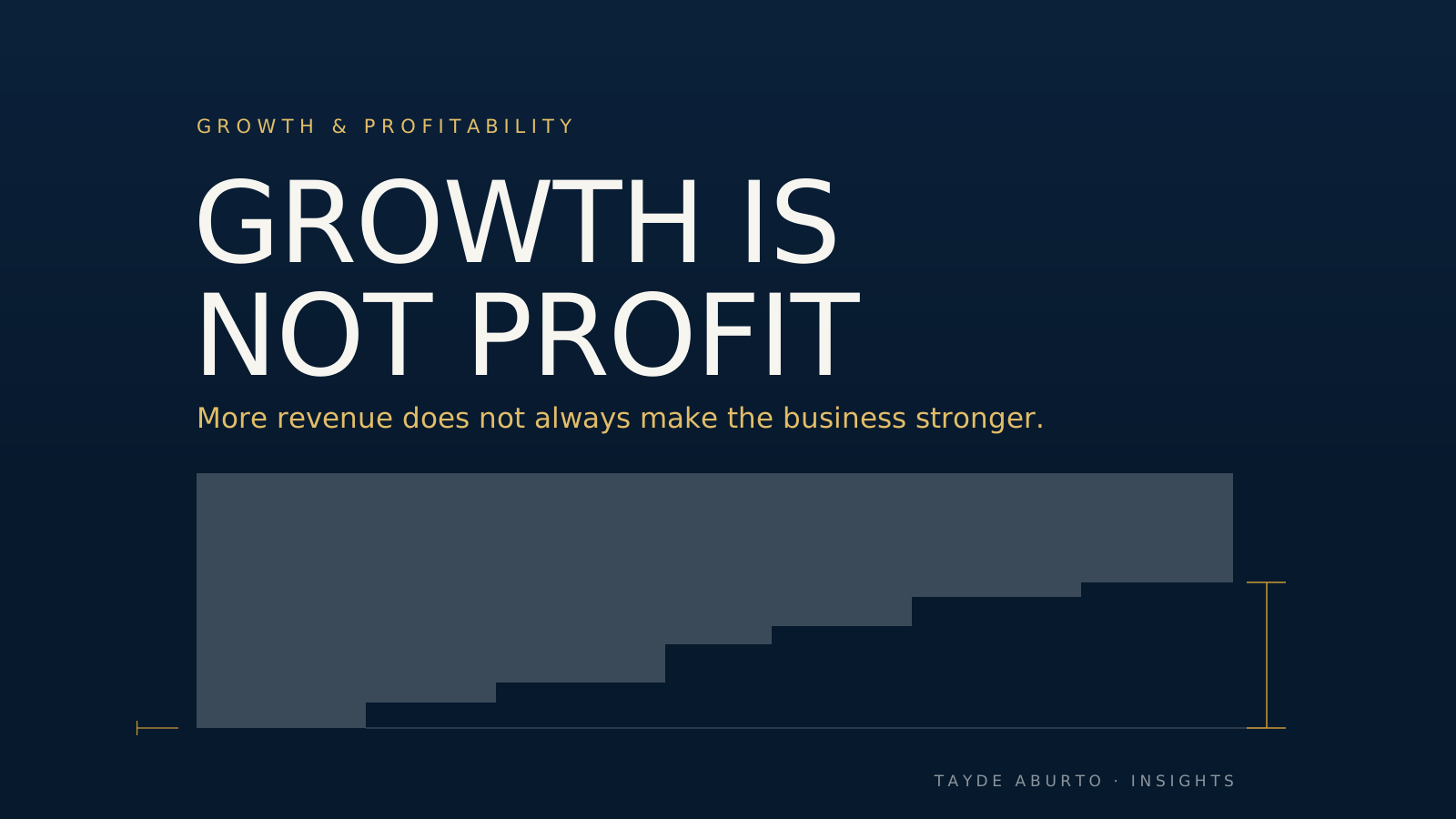
A growing business is supposed to feel like progress. More customers. More sales. A bigger team. More work moving through the company.
But then you look at the bank account, or at what the business is actually producing for you, and something does not add up. Revenue is higher. The business is busier. Yet there does not seem to be much more money left. Sometimes there is even less.
That can lead an owner to a dangerous conclusion: we just need more sales.
Maybe. But if the business is already growing and that growth is not translating into better profitability or stronger cash flow, adding more revenue may simply make the underlying problem bigger.
The better question is: where is the additional revenue going?
That question changes the conversation from how do we grow faster to what is actually happening inside the business. And there are seven places I would look first.
1. Your revenue is growing faster than your gross profit
Revenue measures what the company sold. It does not tell the owner how much economic value remains after delivering those sales.
Consider a business that grows from $1,500,000 to $2,000,000 in revenue. Before, gross margin was 40%, so $1,500,000 of revenue produced $600,000 of gross profit. After, gross margin has slipped to 32%, so $2,000,000 of revenue produces $640,000.
Revenue increased by $500,000. Gross profit increased by $40,000.
That additional $40,000 still has to absorb every increase underneath it: payroll, rent, software, insurance, marketing, administration and the rest of the operating cost the larger business now carries. A company can add half a million dollars of sales and be left with less than it started with.
What to look at
Three growth rates, side by side, over the same period.
Revenue growth. What the company sold.
Gross profit growth. What remained after delivering it.
Operating profit growth. What remained after running the business that delivered it.
If revenue increased 25% while gross profit increased 5%, the difference is the question. It is not automatically a problem, but it is never nothing, and it will not explain itself.
The decision. Before asking how to generate more revenue, determine whether the revenue you are already adding is producing enough gross profit to justify the work required to create it.
2. Your pricing has not kept up with your costs
Prices can hold steady for years while almost everything underneath them moves. Labor increases. Materials increase. Insurance rises. Software accumulates a subscription at a time. Vendor pricing changes. Shipping changes. Customer expectations increase, and the work quietly expands to meet them.
Something that once cost $600 to deliver might now cost $720. If the selling price has not adjusted, margin absorbs the difference, silently, on every unit, including all the new ones growth is producing.
What to look at
The common version of this question is when was the last time we raised prices? It is the wrong one, because it measures the calendar rather than the business.
The better question is: what does it cost us today to deliver what we sell?
Then ask it by product, by service, and by major revenue category rather than across the company as a whole. A blended margin can look acceptable while it is averaging something healthy against something that is not.
This is where growth and pricing meet, and the finding is often uncomfortable: the company's fastest-growing offer may also be one of its least profitable. Volume is not evidence of economics. Sometimes it is evidence that the price is too low.
3. You are growing the wrong revenue
Not all revenue has equal economic value, and the income statement is not where the difference shows up.
Two customers each generate $50,000. One pays quickly, buys a high-margin service, requires little support, fits inside existing capacity, and comes back. The other negotiates hard, requires customization, consumes management attention, pays slowly, generates rework, and creates an exception the business now has to remember.
Both appear as $50,000. They are not economically equivalent, and a business that grows by adding more of the second one will be busier, larger, and worse off.
What to look at
Segment the revenue: by customer, by product or service, by channel, by location where that matters, and by customer segment. Then look at each segment's contribution to two different things.
Profit. What the business actually keeps.
Capacity. What the business had to spend to deliver it; not in dollars, in the constrained resource. Management attention, skilled labor, equipment hours, the owner's judgment.
The question underneath the whole exercise is short: what should we want more of? Most businesses can answer it about their products. Far fewer can answer it about their customers, and that is usually where the money is.
4. Growth is creating more overhead than you expected
Growth is rarely free, and it is rarely temporary. Serving more volume tends to create permanent infrastructure: employees, a layer of management, more space, vehicles, software, insurance, administration, accounting, technology. Each addition is defensible on the day it is made. The structure they add up to is what has to be paid for every month afterwards.
Take a year in which growth produced $300,000 of additional gross profit. Supporting it required $110,000 in additional payroll and benefits, $45,000 in additional marketing, $30,000 in software and technology, $25,000 in facilities and equipment, and $60,000 in other operating expenses. That is $270,000 of additional operating cost against $300,000 of additional gross profit.
The business is meaningfully larger. Operating profit improved by $30,000.
What to look at
Compare the increase in gross profit with the increase in operating expense required to support it, over the same period, as one number against another.
Then ask the question that comparison exists to answer: does the additional gross profit created by this growth justify the additional cost structure we built around it?
Sometimes the honest answer is yes, and the structure is an investment that has not matured. Sometimes the answer is that the business bought a permanent cost to serve a temporary increase.
5. Your business has hit a capacity constraint
Every business has a point beyond which additional volume costs more to deliver than the volume before it. Growth does not stop at that point. It continues through it, and the symptoms are operational before they are financial.
Employees work overtime. The owner approves everything. Equipment runs at its limit. Scheduling becomes difficult. Customer service slips. Mistakes increase. Projects take longer. Rework appears and then recurs.
A business in this condition is growing through a constraint rather than past it, and the next increment of revenue can be materially less profitable than the one before it.
What to look at
Ask one question of the operation: where does work begin to pile up when sales increase?
The answer is usually specific and usually known to somebody. It may be sales, estimating, production, fulfillment, customer service, management, billing — or the owner, who is the constraint more often than any process is.
This is the place where the reflex to spend does the most damage. More marketing is not the answer to a capacity problem. Generating more demand in front of a constraint does not relieve the constraint; it increases the cost of hitting it, and it converts a delivery problem into a reputation problem. If the diagnosis has not been made yet, the cause of slowing growth has more than one place to live.
Growth exposes the architecture of a business. When volume increases, weak pricing, inefficient processes, poor customer mix and capacity constraints become more expensive.
6. The profit exists — but the cash has not arrived
Profit and cash are not the same thing, and a growing company can report one while consuming the other.
The timing is the whole problem. The company completes the work and recognizes the revenue. The customer pays in 30, 45 or 60 days. The employees who did the work were paid weeks ago, and the suppliers who provided the materials have already been settled. Growth widens that gap on every new dollar of sales, which is why a business can be more profitable and less liquid in the same quarter. A profitable business can still have no room to move.
What to look at
Six places cash goes that the income statement does not show as an expense.
Accounts receivable. Are customers taking longer to pay than they used to?
Inventory. Is more money sitting on shelves?
Work in progress. Are projects being financed by the business before the customer is billed?
Capital expenditures. Did cash go into equipment, vehicles or technology?
Debt. How much cash is going toward principal, which never appears on the income statement at all?
Owner distributions. How much is leaving the business outside ordinary operating expense?
Two measures answer two different questions, and a growing business needs both. Profitability asks whether the work is worth doing. Cash conversion asks how long the business waits to see it, and whether it can carry the wait.
7. The business has become more complex than it needs to be
Complexity accumulates the way overhead does, one reasonable decision at a time. Another product. Another service. Another customer type. A pricing exception made once for a good reason. Another piece of software. Another recurring meeting. Another approval. Another vendor. Another process built around one of the others.
None of it appears as a line item. Complexity does not cost one large amount; it costs hundreds of small ones, distributed across people who have stopped noticing them.
What to look at
Ask the team a question the financial statements cannot answer: what has become harder as we have grown?
The answers point at the cost. Waiting. Work repeated because it was not captured the first time. Exceptions that now need to be remembered. Situations that route to the owner. Customer requirements that exist for one account. Approvals nobody can justify. Two tools doing one job. Scheduling that no longer fits the work. Processes designed for a smaller company that are still being run by a larger one.
Removing complexity rarely produces one visible saving. It produces capacity, and capacity is what makes the next increment of growth profitable.
The numbers should tell a story
Read in sequence, seven measures describe what growth is doing to the business. Each answers one question, and the order matters, because each one explains the next. The first six come off the financial statements; the seventh, capacity, is read in the operation rather than on a statement.
Revenue. Are we actually growing?
Gross margin. Are we keeping enough from what we sell?
Gross profit. Is growth producing more economic value?
Operating expenses. What did we add to support the growth?
Operating profit. Is more of the growth reaching the bottom line?
Cash flow. Is accounting profit turning into usable cash?
Capacity. Can the business handle additional growth efficiently?
Two companies can report the same headline and be in entirely different conditions.
One. Revenue up. Gross margin down. Gross profit up slightly. Payroll up significantly. Operating profit down. Accounts receivable up. Cash down.
The other. Revenue up. Gross margin up. Gross profit up. Operating expenses up slowly. Operating profit up. Cash up.
Both are growing. Only the underlying economics reveal which one is getting stronger.
What this doesn't tell us
These seven areas are diagnostic starting points, not conclusions.
A declining margin is not always bad. Higher overhead is not automatically waste. Lower cash does not automatically mean distress. A temporary decline in profitability can be an entirely rational decision — if the owner understands why it is happening, how long it should last, and what return the investment is expected to produce.
What separates an investment from a leak is not the direction the number moved. It is whether anyone chose it.
So the objective is not to find numbers that changed. It is to understand what changed, why it changed, and whether that change supports where the business is trying to go.
A Business Growth Architect's perspective
I think of a business as a connected system.
Financial performance, customers, marketing, operations, people and capacity affect one another. A problem that appears to be about sales may actually begin with pricing. A profitability problem may originate in operations. A cash problem may be the consequence of rapid growth.
That is why I don't believe business owners need more disconnected advice. They need clarity about what matters most now.
A Business Growth Architect looks across a company’s financial performance, customers, marketing, operations, people and capacity to identify the constraints and opportunities that matter most — and help the owner make better decisions about what comes next.
Better decisions build better futures.
- 01Read the six financial measures in order over the same period — revenue growth, gross margin, gross profit, operating expenses, operating profit, cash flow — and note the first one that moves differently from the one before it. Capacity, the seventh, is assessed in the operation rather than on a statement.
- 02Segment the revenue by customer, product or service, and channel, then ask which customers are genuinely the most profitable rather than the largest.
- 03Identify which products or services produce the strongest margins, and check whether they are the ones that grew.
- 04Establish where overhead increased, and whether each addition was a permanent structure bought to serve a temporary increase.
- 05Find the point in the operation where work piles up when sales rise, and name it before spending anything on more demand.
- 06Trace where cash is getting tied up — receivables, inventory, work in progress, equipment, debt principal, distributions — and how long the business is waiting.
- 07Ask the team what has become harder as the company has grown, and treat the answers as the cost of complexity rather than as complaints.
- 08You are looking for the point where growth stops becoming economic progress. Once you find it, the next decision usually becomes much clearer.
A business can grow and still become less profitable, and that does not necessarily mean the growth was a mistake. It means revenue alone cannot tell you whether the company is getting stronger. If the business is busier but you are not seeing more money, look beneath the top line — at margin, pricing, customer and product mix, overhead, capacity, cash and complexity. The goal is not to build a bigger business. The goal is to build a stronger one.