

Skip to content
Small-business advocacy

The people building businesses should have a voice in the decisions shaping their future.

Policy, technology, access to capital and economic opportunity can change the trajectory of a business long before an owner feels the impact.

My advocacy work focuses on helping decision-makers better understand what entrepreneurs and small-business owners are experiencing — and where institutions, industry and public policy can help create stronger conditions for businesses to grow, adapt and build lasting value.

A full auditorium of attendees seated in tiered rows, watching and photographing a conversation on stage.
Why advocacy matters

A business does not operate in isolation.

A business owner can make the right decisions about customers, pricing, hiring and operations and still be affected by forces far beyond the four walls of the company.

ACCESS TOCAPITALTECHNOLOGYREGULATIONFINANCIALCAPABILITYPROCUREMENTWORKFORCEDIGITALINFRASTRUCTUREECONOMICOPPORTUNITYONE BUSINESS
EIGHT CONDITIONSACCESS TO CAPITALTECHNOLOGYREGULATIONFINANCIAL CAPABILITYPROCUREMENTWORKFORCEDIGITAL INFRASTRUCTUREECONOMIC OPPORTUNITYONE BUSINESS
Eight conditions an owner does not set, and cannot opt out of.

Those conditions influence who can start a business, who can compete, who can survive disruption, and who has the opportunity to turn business ownership into long-term wealth.

That is why small-business advocacy matters. Not because every business needs the same policy — but because the people making consequential decisions should understand how those decisions reach the businesses expected to operate under them.

The stepOne example
Institutional decisionThe cost of capital moves
Business conditionBorrowing becomes more expensive
Owner decisionThe equipment purchase is postponed
Business outcomeCapacity stays where it is
Family & communityA hire that would have happened, does not

One institutional decision, traced to a household. The example is illustrative — it shows the shape of the pathway, not a measured case.

The shape of the work

The work happens on both sides of the business.

Inside the business

Help owners make stronger decisions.

  • Growth
  • Profitability
  • Customers
  • Operations
  • Technology
  • Financial decisions
  • Enterprise value
Around the business

Help institutions understand what those owners need to succeed.

  • Public policy
  • Access to opportunity
  • Financial capability
  • Technology adoption
  • Small-business competitiveness
  • Economic mobility
The same principle

Understand the situation before recommending the solution.

Advocacy priorities

Five durable priorities, held as questions.

These are the areas I keep returning to. They are deliberately written as priorities and open questions rather than as positions — a position on a specific measure is something to reach after investigating it, not before.

01Small-business competitiveness

Small businesses should have a realistic opportunity to compete as markets, technology and customer expectations change.

That means understanding the practical consequences of economic and policy decisions for businesses operating with limited capital, limited time and limited organizational capacity.

The question

What helps more businesses become stronger — not simply survive longer?
02Financial opportunity

Access to financial products matters. So does understanding how to use capital responsibly, and how financial decisions affect the long-term health of the business.

The goal should not simply be more financing. It should be better financial capability, stronger capital readiness, and greater opportunity to turn business success into financial security.

The question

Are we expanding access while also helping owners make better financial decisions?

03AI & the digital economy

AI and digital tools can expand the capabilities of a small business — but access to technology alone does not guarantee competitiveness.

Entrepreneurs also need practical pathways for adoption, trusted education, and the ability to understand where technology creates real leverage.

The question

Will the next generation of business technology widen opportunity — or widen the gap between businesses that can use it and those that cannot?

04Entrepreneurship & economic mobility

Business ownership can create income, independence, employment and community investment. At its best it can also create assets and opportunities that extend beyond the founder.

Advocacy should therefore look beyond business formation, and ask what helps entrepreneurs build companies capable of creating durable economic value.

The question

How do we help more entrepreneurs move from starting a business to building an asset?

05Financial capability & generational prosperity

Financial education is not simply about knowing more financial terms. It is about expanding the quality of decisions families and business owners are able to make.

Greater financial capability can affect how people save, invest, protect what they build, and create opportunities for the next generation — which is where financial confidence actually comes from.

The question

What changes when more people have the knowledge and tools to make informed financial decisions?

The advocacy model

Bring the experience of business owners closer to the people making consequential decisions.

Listen
  • Business owners
  • Entrepreneurs
  • Community organizations
Understand
  • Where opportunity exists
  • Where friction exists
  • What is changing
  • What the data does — and does not — show
Translate
  • Business experience
  • Research
  • Economic implications
  • Practical policy considerations
Engage
  • Companies
  • Government
  • Policymakers
  • Institutions
  • Industry organizations
Enable better conditions
  • Competitiveness
  • Opportunity
  • Financial confidence
  • Economic mobility

Effective advocacy begins before the policy recommendation. It begins with understanding what businesses are experiencing, separating isolated anecdotes from broader patterns, and translating those realities into information decision-makers can actually use.

Every economic statistic eventually reaches a person making a decision.

A percentage point in borrowing costsbecomes a postponed equipment purchase.
A new technologybecomes an advantage for one company and another barrier for a business without the resources to adopt it.
A procurement opportunitybecomes a new customer.
A financial decisiondetermines whether business success becomes personal financial security.
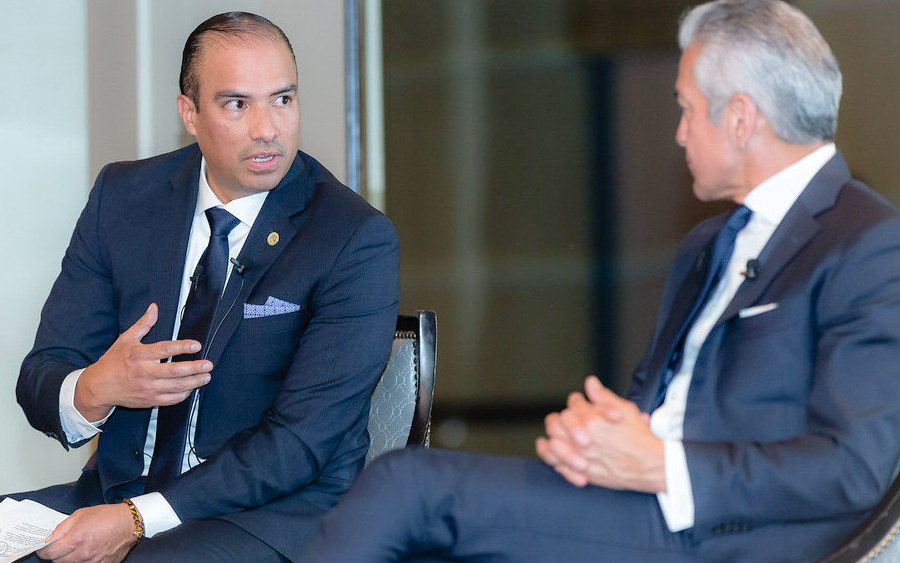
Tayde Aburto seated in a public conversation, gesturing mid-sentence while the other participant listens.
The work begins with listening — because better decisions are made when the people affected by them are part of the conversation.

That is why I believe good advocacy requires both economic perspective and proximity to the people experiencing the consequences.

In practice

Advocacy can take many forms. The responsibility is the same.

Whatever the format, the obligation does not change: represent what businesses are actually experiencing, and be honest about the limits of what is known.

Listening

Conversations with entrepreneurs and community leaders help identify where policies, programs and markets are working — and where lived experience is different from the intended result.

Research

Data and economic analysis help determine whether an issue is isolated, structural, or still too uncertain to support a conclusion.

Convening

Bringing business owners, corporations, policymakers and institutions into the same conversation can surface perspectives that rarely appear in the same room.

Policy engagement

Providing practical small-business perspectives to leaders considering issues that affect entrepreneurship, financial opportunity and the digital economy.

Coalition building

Some challenges are larger than any one organization. Partnerships can align expertise, reach and resources around issues where there is genuine common ground.

Public communication

Speaking, writing and media can help make complex economic and small-business issues more understandable to wider audiences.

Point of view

Advocacy should begin with understanding — not with a predetermined answer.

A constituency deserves more than someone willing to argue its side. It deserves someone willing to investigate the issue, understand competing considerations, identify where evidence is strong or incomplete, and determine where meaningful progress is possible.

That means advocacy should be principled without becoming reflexive, and practical without losing sight of the people affected.

The wider field

Four questions that belong to one argument.

  1. 01Who participates
  2. 02Who may be left out
  3. 03What is changing
  4. 04What outcome matters
01 · Who participates

Better outcomes often require people who do not normally sit on the same side of the table.

The objective is not collaboration for its own sake. It is finding the areas where different interests can produce meaningful value for small businesses.

01Entrepreneurs & small-business ownersThe people experiencing the issue directly.
02CorporationsOrganizations whose platforms, capital, technology, supply chains and policy priorities can materially affect small businesses.
03Government & policymakersLeaders shaping the conditions under which businesses operate.
04Financial institutionsOrganizations with an important role in financial opportunity, capital access and financial capability.
05Associations & chambersOrganizations capable of aggregating business experience and turning individual voices into broader representation.
06Educational & community institutionsPartners that can help translate opportunity into practical knowledge and local impact.
02 · Who may be left out

Representation matters most when it changes what people understand.

For much of my advocacy work I have focused on entrepreneurs and communities whose experiences are often discussed in aggregate but less frequently understood at the operating-business level.

Hispanic-owned businesses are an important part of that work. So are entrepreneurs navigating limited access to capital, technology, financial education, institutional networks and other resources that can influence business competitiveness.

The objective is not simply visibility

Better understanding. Stronger participation. Greater economic opportunity.

03 · What is changing

AI may become one of the defining small-business competitiveness issues of the next decade.

Large companies can deploy capital, people and specialized expertise to understand new technologies quickly. A small-business owner often has to make the same decision while also managing customers, employees, cash flow and operations. That creates a different policy and economic challenge.

01

Can small businesses access AI?

02

Can they understand it?

03

Can they use it safely?

04

Can they identify where it creates real economic value?

05

Can they keep pace as competitors adopt it?

06

Can technology increase their capabilities without requiring resources they do not have?

The opportunity is not merely democratizing access to AI. It is democratizing the ability to use it well.

04 · What outcome matters

The goal is bigger than creating more businesses.

Business formation matters. Revenue matters. Jobs matter. But entrepreneurship has greater economic impact when a successful business keeps going — past income, into something that can be held, transferred and built on.

01Income
02Stability
03Assets
04Options
05Wealth
06Opportunity for the next generation

That is why the work across business growth, financial education and advocacy points at the same outcome.

Stronger businessesHealthier financesGreater economic mobility

Those are the terms this page uses. Elsewhere in the work the same idea is described as financial confidence and generational prosperity — measured from the household rather than from the business.

How the work is evidenced

A standard, published before there is work to show.

Advocacy work is easy to describe and hard to evidence. So the standard is set out first, in public: four fields that a documented piece of work has to fill before it appears here. Nothing is claimed on this page today.

  1. 01
    The issue

    What the question actually is, stated without a predetermined answer.

  2. 02
    What was heard or observed

    The conversations and observations, and how many — enough to distinguish a pattern from an anecdote, or honestly not.

  3. 03
    The conversation

    Who was brought into it, what was put in front of them, and what was asked.

  4. 04
    Why it mattered

    What changed in understanding, and for whom.

The rule that governs the fourth field

Outcomes are claimed only where they can be evidenced.

Continue the conversation
Insights

Read my latest thinking on business competitiveness, AI, financial confidence and economic opportunity.

Read Insights
Speaking

Bring these conversations into your organization, conference or leadership forum.

Explore Speaking

Also on LinkedIn

Start a conversation

If your work touches small businesses, there may be something worth discussing.

Whether you are developing policy, building a small-business initiative, researching an economic issue, or exploring where your organization can create meaningful impact, I am interested in conversations grounded in a simple question:

What would make this genuinely useful to the businesses we are trying to serve?

Advocacy inquiries · institutions, research, initiatives and coalitions